
They cannot find the page
Service, product or warranty information is spread across the website.
Make core answers readable and findable first.
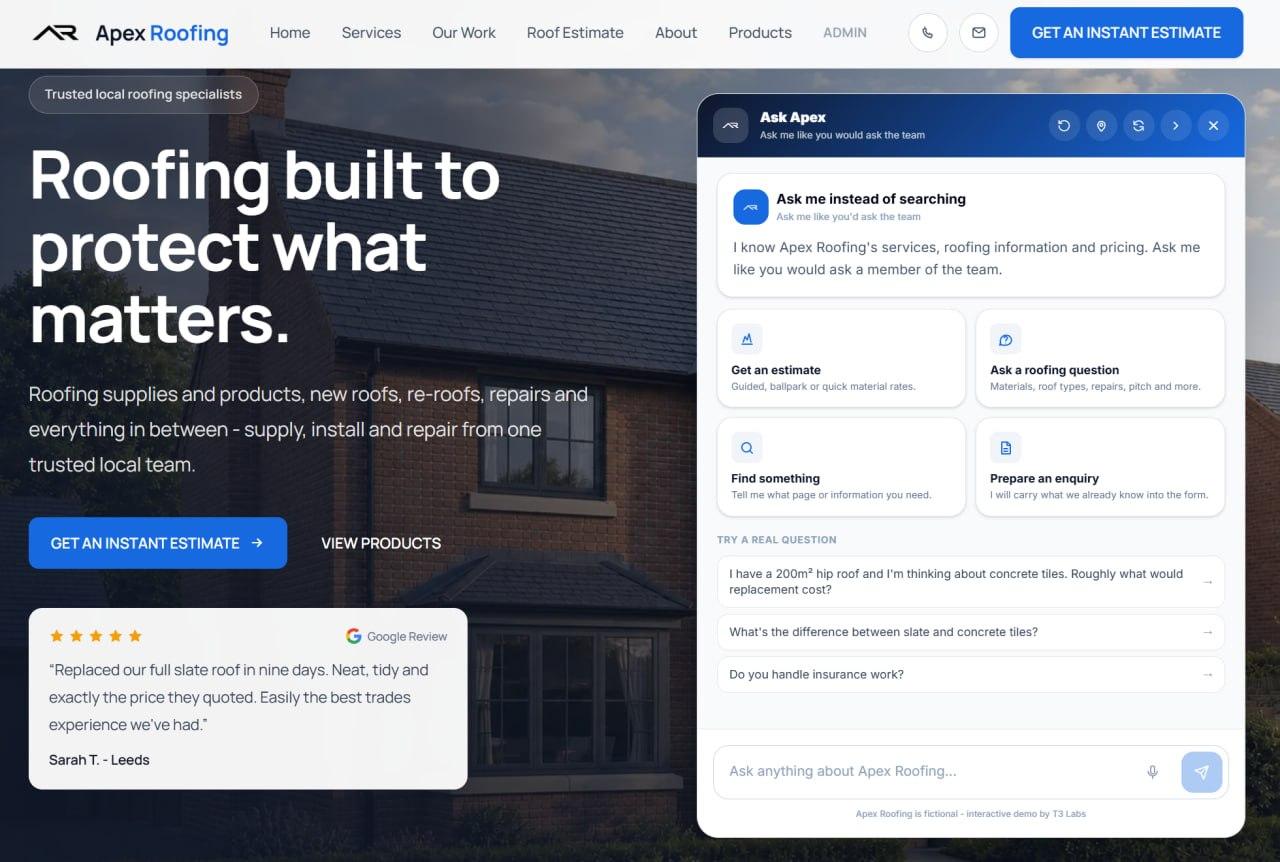
A website smart assistant can answer approved questions about roofing services, materials, locations and indicative pricing, even after hours. If an answer needs a person, it gathers the details and hands over instead of guessing. We configure its knowledge and boundaries around your business.
Explore a guided assistant example. Your business controls the information it uses, the kinds of questions it answers and when it directs a visitor to your team.
Real assistant examples with guided questions and enquiry handoffs, not a generic AI promise.
Jobber’s 2026 US home-services customer survey found more than half of customers expected a response within an hour. Immediate approved answers can serve that need, but they do not replace inspections or human decisions.
Source: Jobber, 2026 US Home Service Trends Report ↗Service, product or warranty information is spread across the website.
Make core answers readable and findable first.
The office is busy and the visitor wants an answer before enquiring.
Use approved knowledge to answer routine questions around the clock.
A question involves site conditions, a final price or a decision the business has not authorised.
Collect the relevant details and hand over without guessing.
Write down the ten questions your team answers every week. Mark which have approved answers and which require human judgment.
“Do you install metal roofs in my area?” or “How does your inspection process work?”
Use your approved services, service areas and processes.
“What might a roof replacement cost?”
Use explicitly approved cost factors or indicative ranges, with clear assumptions.
“Can you guarantee tomorrow?” or “Is this roof safe?”
Do not speculate. Explain that a person must confirm and offer a short enquiry.
A smart assistant should not invent warranties, commit to a final price, assess a roof’s safety or guarantee appointments unless the business has supplied and authorised the answer.
The useful part of a roofing website assistant is the approved information and the hand-off rules. It should not guess a price, promise an installation date or diagnose a leak from a short chat.
‘Do you work on metal roofs in my suburb?’ It should answer only from your approved service and location information.
‘What will my reroof cost?’ It can explain price factors or offer an indicative estimator, but not invent a binding quote.
‘My roof is leaking near electrical fittings.’ It should avoid unsafe troubleshooting and direct the person to appropriate human help.
Start with a small, reviewed set of real customer questions. Test incorrect, incomplete and out-of-scope questions before increasing the assistant's autonomy.
Approved-answer accuracy, escalations, qualified enquiries transferred, and unanswered or misleading responses found during reviews.
A scenario to help you picture the process, not a claim about a particular customer's results.
A visitor wants to know if a particular product or service is suitable after office hours.
Provide clear answers grounded in approved business information and hand off uncertainty or project-specific advice to a person.
Count enquiries with relevant context passed to the team; also review incorrect or unanswerable queries.
Yes, if your business approves the pricing information and clearly defines when an answer must go to a person.
No. It is useful for routine, approved information and collecting context. It should hand off uncertain or consequential decisions.
Not by itself. Publish core services, pricing factors and locations as accessible website text; the assistant then helps visitors once they arrive.
Tell us what is holding your roofing business back. We will review what you already have and recommend a sensible next step.