
No early guidance
A visitor wants to know the likely budget before committing to a call.
Explain what changes a roof price and offer an indicative range where appropriate.
An online roofing estimator asks a homeowner simple questions and gives an indicative range based on rules you approve. It answers the budget question without publishing a fixed price list, and the customer can carry their answers into an enquiry. The result is guidance, not a final quote.
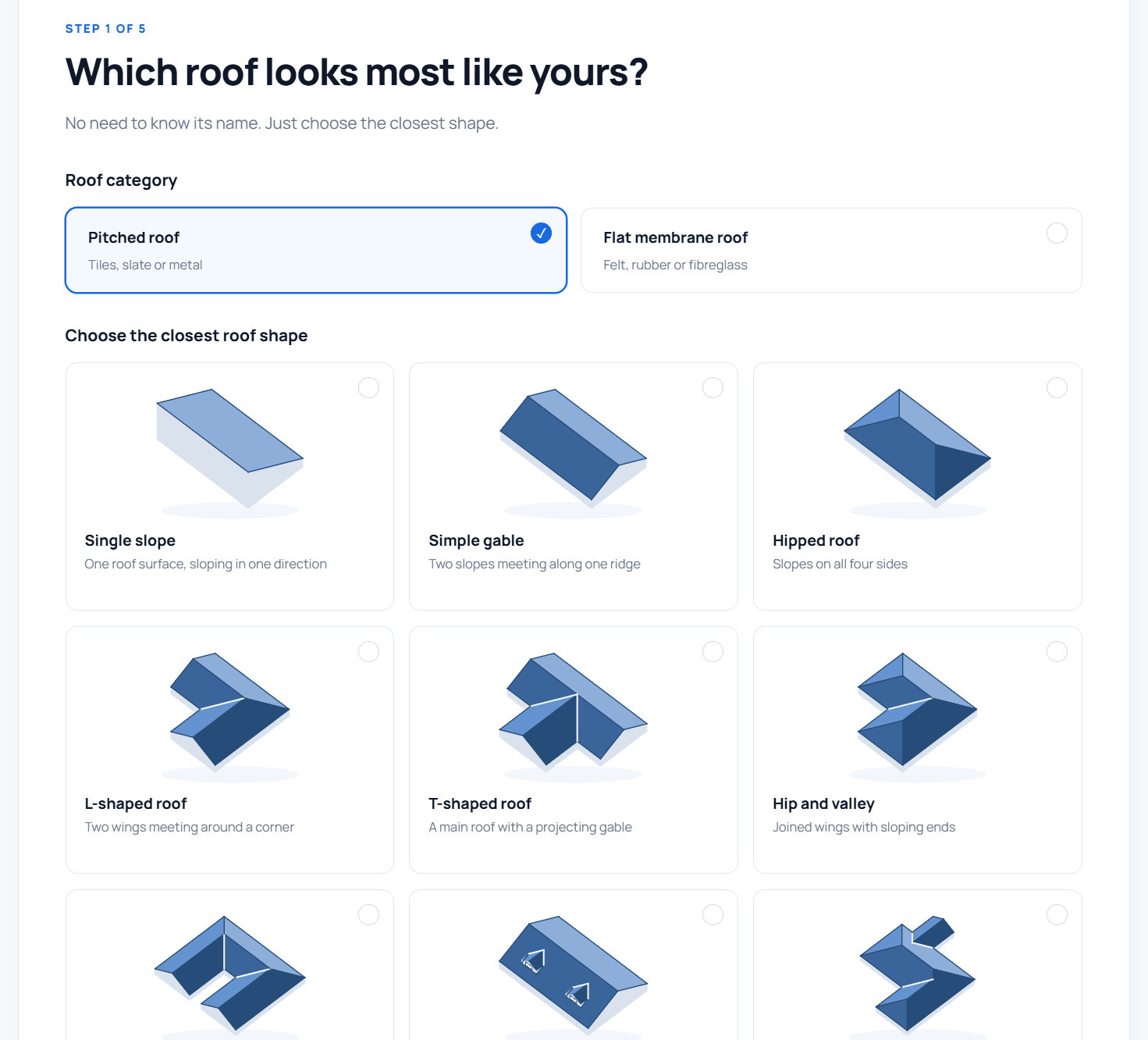
This real T3Labs demo starts with easy roof-shape choices and guides a homeowner towards an indicative estimate. Their answers can flow into an enquiry if they want to continue.
A real visual estimator already built by T3Labs. Configured for your questions and pricing boundaries.
In Jobber’s 2026 US home-services customer survey, 62% selected price as an important hiring consideration. This is a reason to explain likely costs clearly, not a claim that an estimator guarantees more sales.
Source: Jobber, 2026 US Home Service Trends Report ↗A visitor wants to know the likely budget before committing to a call.
Explain what changes a roof price and offer an indicative range where appropriate.
The customer cannot estimate roof pitch, profile or materials correctly.
Use simple illustrations, plain language and sensible options.
After answering questions, the visitor has to repeat everything to your team.
Carry their selections into a pre-filled enquiry, with appropriate consent.
List the five homeowner questions you need to give a sensible ballpark range. Replace trade jargon with pictures or plain-English choices.
You are not ready to produce meaningful online ranges.
Publish service-specific pricing factors, exclusions and why an inspection is required.
You can approve ranges or rules for common work types and want better-prepared enquiries.
Use a short visual questionnaire and show a clearly qualified range.
Your materials, roof categories or job rules need unusual steps.
Design the inputs, calculation and enquiry handoff around your actual quoting process.
Indicative price ranges cannot identify concealed defects, access constraints or all site conditions. Explain assumptions and require appropriate contractor review before final pricing.
A homeowner-facing estimate is an early conversation aid. It should explain its assumptions, gather useful details and invite a site-specific review, not masquerade as a binding roofing quote.
Use diagrams or plain-English options for roof shape and size; do not require precise technical measurements from a homeowner.
Show what the indicative figure assumes and what could materially change it: access, existing roof condition, material, pitch and unforeseen work.
With consent, pass selected answers to the roofing team so the first call can focus on the unknowns and next inspection step.
Use an estimator to qualify initial interest. Keep final job pricing subject to inspection, verified measurements, product choices and the contractor's approval.
Track estimator starts, useful completions, opt-in enquiries and the proportion that match your actual service area and project types.
A scenario to help you picture the process, not a claim about a particular customer's results.
A homeowner wants a ballpark roof price before talking to a contractor.
Offer a short visual questionnaire using your own pricing boundaries, clearly label the range as indicative, and pass answers into a prefilled enquiry.
Review how many estimates become enquiries with enough project detail to respond usefully.
No. You can configure qualifying questions, assumptions and indicative ranges instead of publishing a binding price list.
The calculator is useful for visitors after arrival. For search visibility, also publish readable information about services, areas and the factors that affect price.
Often yes, depending on the site platform and required workflow. We check integration, accessibility, privacy and the enquiry handoff before recommending a format.
Tell us what is holding your roofing business back. We will review what you already have and recommend a sensible next step.